Experiment Steps
Project plans are crucial for validating the ideas selected during the selection process. After going through the innovation funnel, the chosen projects enter a practical phase, where they will be tested and evaluated in real conditions. This stage aims to collect data, measure results and ensure that the proposals can be implemented in an effective and sustainable way. With a structured and methodological approach, the Experiment Stages provide valuable insights that can influence future decisions and improve the innovations developed.
Planning: Definition of objectives, hypotheses to be tested and success metrics. This phase is critical to ensuring that the experiment is aligned with project expectations and desired results.
Execution: Practical implementation of the **project plan **in a controlled environment or in the field, depending on the nature of the project. During this stage, data is systematically collected for further analysis.
Result Analysis: After execution, it is necessary to evaluate the collected data to check whether the hypotheses were confirmed or refuted. This analysis allows for an in-depth understanding of project performance and identifies areas for improvement.
Adjustments and Iterations: Based on the analysis of the results, adjustments can be made to the original proposals, ensuring that innovations are refined and adapted to meet the needs of the market and users.
Following these principles, project plans serve as a structured process that aims to provide an effective path for validating and implementing innovative ideas, ensuring that the best proposals are chosen and improved for success in the market.
Structure of the CProject Plan Schedule
The project plan stages represent a crucial phase in the innovation process, allowing practical validation of selected ideas. After completing the selection funnel, projects enter a testing and evaluation phase that aims not only to confirm the feasibility of the proposals, but also to improve their characteristics based on data collected in real conditions. This pragmatic approach is fundamental to ensuring that the innovations developed meet market and user expectations, contributing to the effectiveness and long-term success of the organization’s initiatives.
Add Step: Process Flexibility
Register Step: is a key element for the effective management of the project plan. When creating a new stage, it is necessary to name it clearly to facilitate guidance and management of the idea per stage in the validation cycle of each project.
 When clicking on “Add Option”, you will need to give the new step added a name.
Delete Step: If a step becomes unnecessary or irrelevant during the process, the user can delete it. This action is essential to keep the validation process lean and efficient, avoiding confusion and providing a more objective and fluid experience for analysis, verification and testing of proposals.
 Movement: The movement option offers flexibility in organizing the steps throughout the plan. With this functionality, users can reorder the criteria according to the evaluation needs, prioritizing or reevaluating criteria to reflect the company’s strategy in real time. This adaptability is crucial in a dynamic innovation environment, enabling the team to respond quickly to changes in market conditions or the organization’s strategic directions.
 Movement of steps.
With these structures and functionalities in place, project plans not only promote practical validation of ideas, but also ensure that the evaluation process is clear, efficient and aligned with the company’s strategic objectives. This ensures that innovations are developed effectively and sustainably, contributing to the continued success of organizational initiatives.
Project Plans Guide
Access Register schedule standard for steps
- On the platform, when editing the call, go to Register standard schedule for steps > Edit
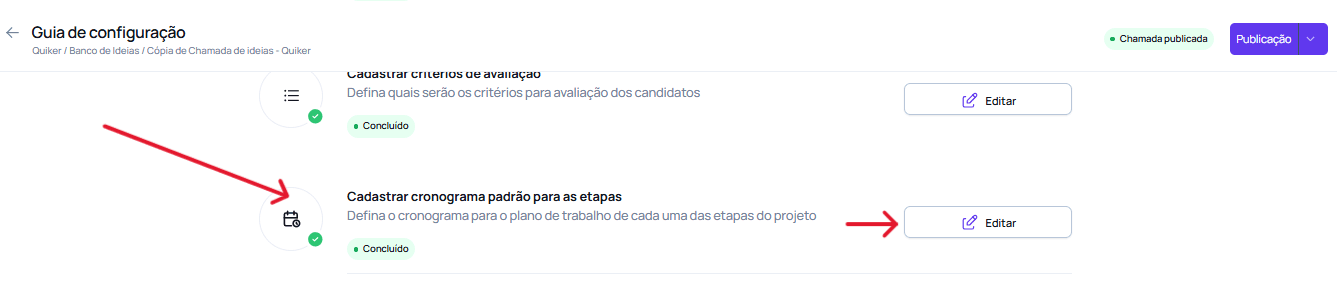
Example of pre-registered project plans
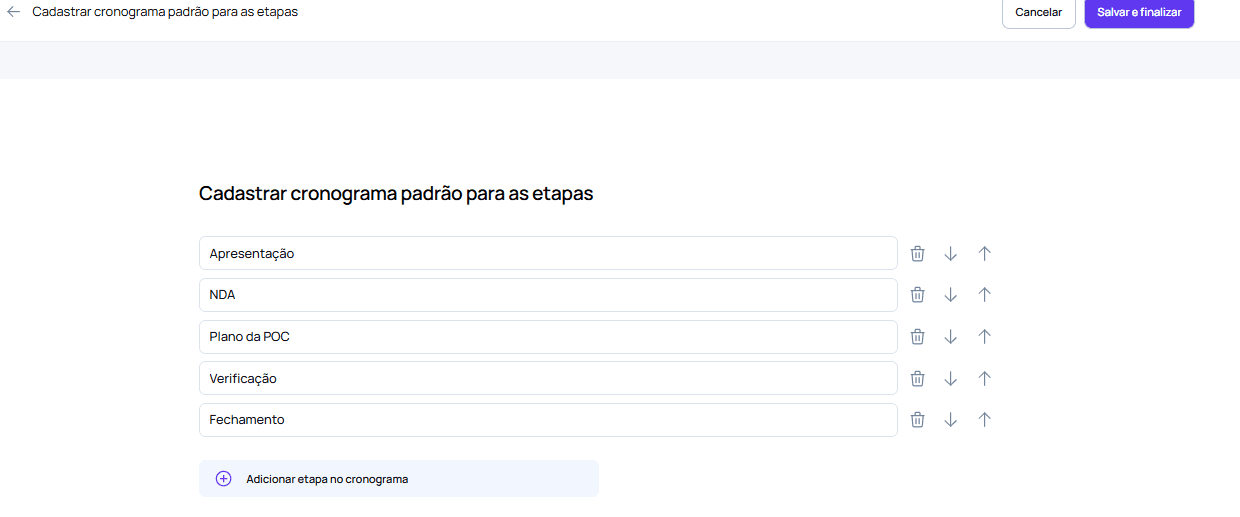
Presentation → NDA → POC Plan → Verification → Closing
Steps:1. **Presentation **→ the selected idea is formally introduced to stakeholders, the team responsible for execution and others involved in the innovation process. This step serves to align expectations, clearly communicate the purpose of the project and ensure that all participants understand what is being proposed. The presentation is the moment to contextualize the idea in the company or market scenario, highlighting its potential value and expected benefits. 2. **NDA **→ before proceeding with the execution of the experiment, it is essential to formalize the protection of sensitive project information through an NDA. The **NDA **(Non-Disclosure Agreement / Confidentiality Agreement) is a legal agreement between the parties involved, ensuring that the details of the proposal, confidential data and experimentation results are not disclosed to third parties without authorization. This phase ensures the security of information and the preservation of intellectual property, preventing misuse or unfair competition. 3. POC Plan → describes how the experiment will be conducted to validate the viability of the idea. In this phase, a detailed plan is prepared that includes the methodology to be used, the necessary resources, the execution schedule and the specific objectives of the test. The POC is a small scale or prototype project, designed to verify whether the proposed solution can be successfully implemented, demonstrating its technical, commercial and operational feasibility before a possible larger investment. 4. **Verification **→ is the time to apply the POC plan and test the idea in a controlled or real environment, depending on what was agreed. During verification, data is collected to evaluate the performance of the proposal in relation to established criteria, such as functionality, usability, market acceptance and expected return. This phase involves measuring results, analyzing evidence and comparing POC results with project objectives. 5. **Closure ** → involves the final analysis of the results obtained during the experiment. At this point, final considerations are made about the performance of the tested idea, including lessons learned, possible improvements and recommendations for the next phase of the innovation process. The closing phase also involves deciding whether to continue the project — whether it will be scaled, adjusted or discarded. Additionally, closure includes formalizing documentation of the experiment, ensuring that all parties involved are clear about next steps, if any.
Example of Experiment Steps
Prototype/MVP → Acceptance Testing → Project Refinement → Implementation → Post Implementation Evaluation
Steps:
**Prototype/MVP → **Selected ideas are transformed into prototypes or MVPs (Minimum Viable Products) for initial testing. In this phase, intrapreneurs work closely with multidisciplinary teams to develop a working model of the idea, which will be used to demonstrate the feasibility of the concept and carry out usability tests.**Acceptance Test → **the prototype is presented to a select group of end users or company stakeholders. The feedback collected during this stage is crucial, as it helps to validate the proposal and identify areas that require improvement before large-scale implementation. Acceptance by the target audience is a determining factor in the success of the project.
**Project Refinement → based on the results of the acceptance test, intrapreneurs refine their proposals. This may include design adjustments, functionality improvements, and adaptation to user needs. The objective of this phase is to prepare the project for a final presentation, ensuring that all recommendations have been considered.
**Final Presentation and Decision → ** employees present their refined proposals to a panel of evaluators, which may include company executives and other relevant stakeholders. This presentation should highlight the acceptance testing results, expected impact, and next steps for implementation. After the presentation, the panel decides on the continuity of the project, which may involve investment in resources, support for implementation or, in some cases, non-continuation of development.
**Implementation → **the developed solution is launched in the company or on the market. During this stage, it is essential to ensure that all processes necessary for implementation are in place, including team training, internal communications and marketing planning.
**Post Implementation Assessment → **measure the performance of the solution in the market. Data on usage, acceptance and financial results are collected, comparing them with established goals. This assessment is essential to understand the success of the innovation and identify opportunities for continuous improvement.
These experimental stages promote an environment of intrapreneurship, where employees can explore their ideas, receive support and transform innovations into tangible results for the company.
Post Registration of Experiment Stages
After completing the Experiment Steps, it is important that all information and results are documented in a clear and accessible way. This will ensure that the learnings acquired during the experiment can be used in future innovation initiatives. Documentation must include:
Experiment Results A detailed description of the results obtained, including quantitative and qualitative data.
Learnings Key insights and learnings that can influence future decisions or adjustments to proposals.
Recommendations Suggestions for implementing innovations, based on analysis of results and feedback obtained.
With this clear and organized structure, the Experiment Stages provide an effective path for validating and implementing innovative ideas, ensuring that the best proposals are chosen and improved for market success.After following the setup instructions, the call is ready to publish. All essential elements were organized to ensure an efficient and well-structured flow, from registration to evaluation and validation of ideas. Now, simply publish the call to start the process and monitor the progress of the proposals with the configured management tools.