Defining Strategies
 Strategy for creating a call
For the success of an innovation call, it is essential to establish a solid foundation of strategy, which will guide the direction of the program. This involves important concepts, such as value chain, innovation theses and strategic territories, which form the foundation for planning initiatives and defining the **Themes and Challenges **of an innovation call
1. Value Chain
The value chain refers to the set of activities that a company carries out to deliver a product or service to the market, from development to final delivery. Defining at which points in this chain innovation can be applied is essential to identify areas where improvements will bring more impact and competitive gains. For example, you can focus on production processes, logistics or customer service, depending on the innovation opportunities that bring the most value.
2. Innovation theses
The innovation theses are strategic guidelines that guide the company on what types of innovation it wants to foster. They can be based on new technologies, changes in consumer behavior or market trends. Defining these theses helps the company to focus its efforts on areas that align innovation with long-term objectives.
3. Strategic territories
Strategic territories are the specific markets, sectors or areas in which the company wishes to operate or expand. They represent the spaces where the organization sees opportunities for growth or strengthening its presence. Defining territories is important to ensure that innovation initiatives are relevant and fit into the company’s operating context.
4. Avenues of Growth
With these clear foundations, we arrive at avenues of growth, which are priority areas where the company wants to expand or improve. The growth avenues guide the creation of the themes and challenges of the innovation call. For example, if the growth avenue is sustainability, one of the themes might be “efficient use of natural resources,” and the challenges might focus on areas like waste reduction or energy optimization.
5. Strategic Alignment and Definition of Priorities
Defining clear strategies is essential to ensure that the innovation program is aligned with the company’s business objectives and maximize the impact of the initiatives. By establishing the avenues of growth, based on the** value chain**, innovation theses and strategic territories, the company directs its efforts to areas where innovation opportunities can generate greater returns. This allows resources to be invested efficiently and the proposed solutions to be connected to the organization’s real needs.
With well-defined strategies, the company is able to guide the focus of proposed innovations, ensuring that each new project or idea has a clear purpose, is aligned with corporate objectives and contributes directly to the sustainable and competitive growth of the organization.> ### _“_Without a clear theory to guide, innovation can end up being a directionless exercise.”
Clayton Christensen - author of The Innovation Dilemma
Call Registration Structure
Before starting to configure an innovation call, it is essential to establish the information and guidelines that will guide the entire process. This step involves defining key elements such as the title, description, type of call, schedule and the themes and challenges that will guide participants. Furthermore, a clear regulation must be drawn up to ensure that all criteria and conditions are well defined from the beginning, promoting a transparent process aligned with the company’s objectives. Below, we will detail each step of the call registration that contains these steps to ensure a complete and effective call setup.
1. Information and Schedule
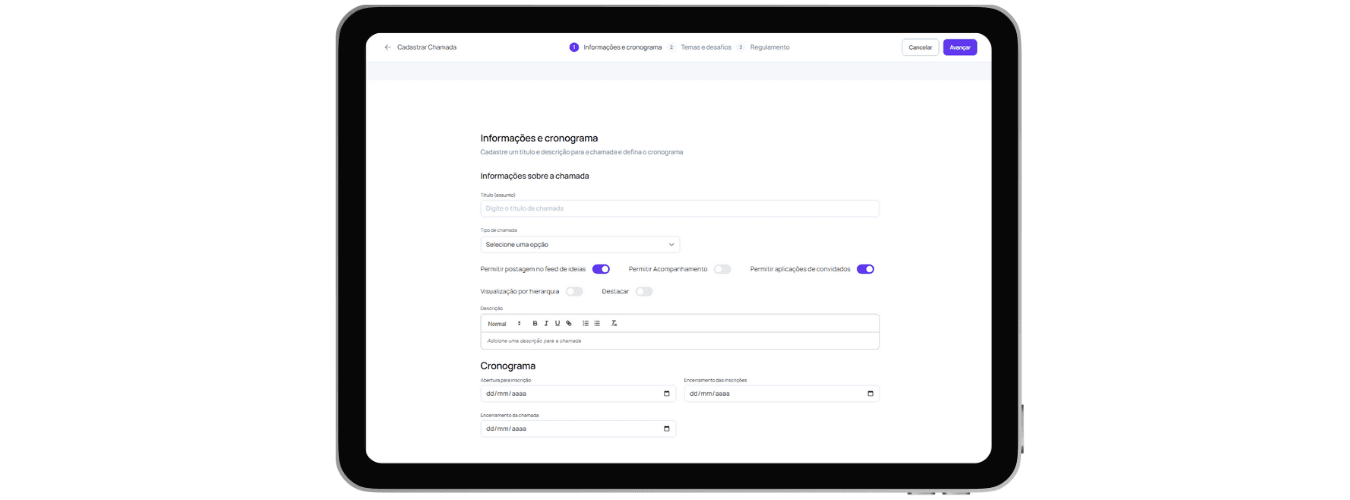
In this step, enter essential information about the call, starting with a descriptive title, which may include the branding or theme of the project. Then, provide a detailed description, explaining the objective of the initiative, the planned steps and the context that supports the call, elucidating what is expected of the participants.
It is also crucial to select the type of call: whether it will be an ideas portal aimed at internal initiatives, with the aim of stimulating innovation among employees, or an open innovation call, which seeks solutions outside the organization. Each format has its own configuration characteristics, for correct design, see how to configure an ideas portal (intrapreneurship) or how to configure an open innovation.
Furthermore, in this step, you must determine the schedule of the call, establishing the start and end dates, as well as the deadlines for submitting proposals. A well-structured schedule ensures that participants can organize their work and submit their proposals within the appropriate time.
2. Themes and Challenges
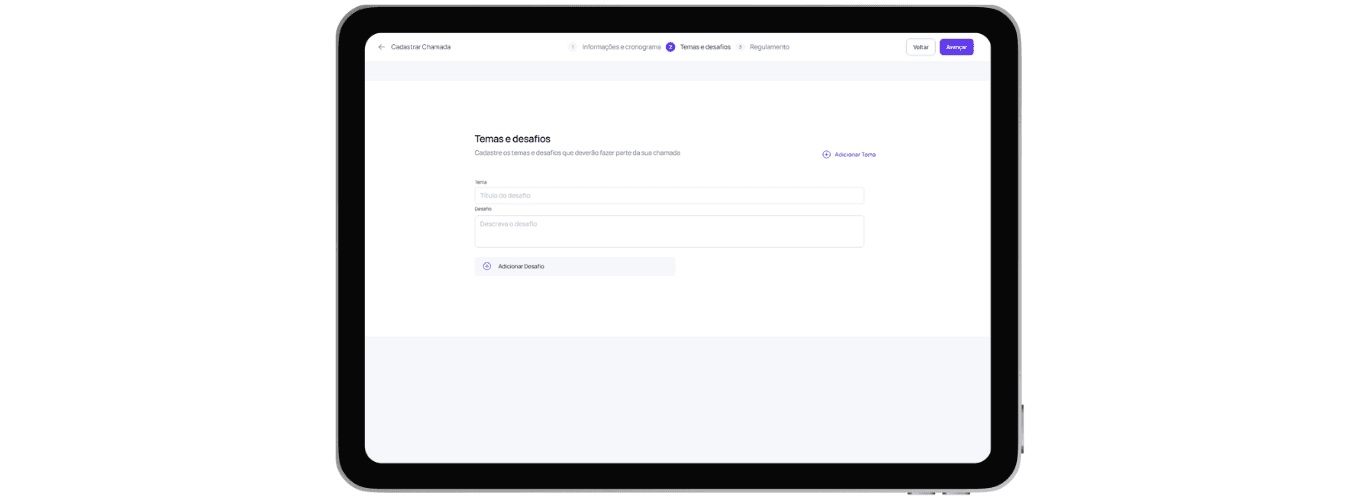
In this step, specify the main themes and challenges of the call, providing clear guidance on the scope and objectives of each topic, according to strategic alignment and priority definition. This step should guide participants on the problems that need to be solved and how the solutions should align with the company’s strategic goals.
Each topic covered must have a clear explanation of its impact, and the specific challenges related to each of them must be well defined to facilitate understanding and direction of the proposals. This helps ensure that participants can focus on areas of greatest interest to the organization, increasing the quality of the proposals received.
It is recommended to define between 2 and 3 main themes, each with up to 4 specific challenges, which will guide participants in developing proposals. These themes and challenges allow the company to test the viability of new ideas, evaluate their impact and select those with the greatest potential for success.
3. Regulation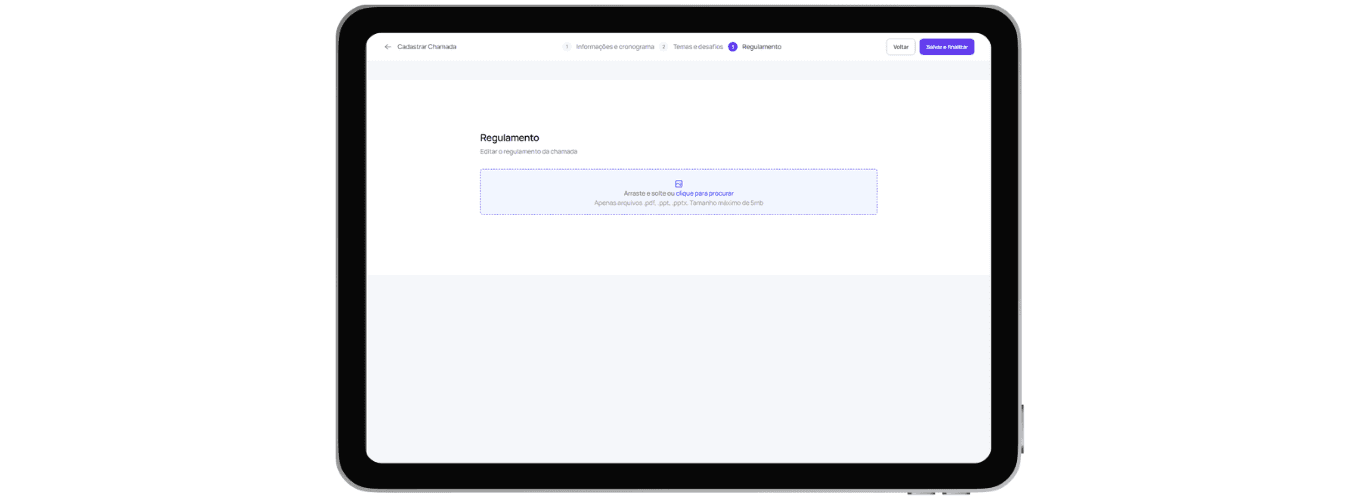
In this section, define the rules and conditions for participating in the call. The regulations must contain all information about the** eligibility criteria**, the intellectual property rights, the responsibilities and duties of the participants, **consent data **provided, as well as any other conditions governing the submission and evaluation of proposals. The regulations must be clear and accessible, ensuring that all participants understand the parameters they must follow.
Call Registration Guide
This guide was created to instruct interested parties about the call registration process in an exemplified and explained way. In it, we present detailed instructions that cover the steps necessary to configure the call in accordance with the complete structure presented previously.
Step 1: Access Register the Call
 Registering a new call or editing a call
-
On the platform, in the administration workspace, go to the created program and click on New Call
Or if the call has already been created, follow:
-
On the platform, when editing the call, go to Call ⁝ > Edit Call > Edit(Register Call)
Step 2: Information and Schedule
 Completing the information and schedule
Configure the main details that will give identity to the call and establish the registration period.
Step 2.1: Set Call Information
- Call Title: Logistics for Operational Efficiency
This title will be displayed in all communications and, mainly, on the pre-registration landing page, facilitating call identification.
- Description: We seek innovative technological solutions that can optimize logistics processes, reduce costs and improve the customer experience. If your company has an idea that can transform logistics and transportation, we want to hear from you!
This description will be the introduction for those interested, capturing the essence and objective of the call.
Step 2.2: Establish Schedule
Set dates for the main steps of the call.
- Call Start Date: 06/01/2025
- Registration Closing Date: 08/01/2025
- Call Closing Date: 12/15/2025
These dates will help participants organize for submissions on time.
Step 3: Themes and Challenges
 Addition of Themes and Challenges
Define the areas of interest and specific problems that the call aims to solve.
3.1: Define Themes and Challenges
Inform the themes that guide the approach to the projects.
Theme 1: Route and Transport Optimization
- Challenge 1: Use of Algorithms for Route Planning
- Challenge 2: Implementation of Autonomous Vehicles
Theme 2: Inventory and Storage Management
- Challenge 1: Intelligent Inventory Control System
- Challenge 2: Reducing Waste in Warehouses
Theme 3: Improving Customer Experience
- Challenge 1: Transparency in Delivery Tracking
- Challenge 2: Customization of Delivery Services
Theme 4: Sustainability in Logistics- Challenge 1: Use of Ecological Packaging
- Challenge 2: Reducing Carbon Footprint
Theme 5: Information and Communication Technology
- Challenge 1: Integration of Logistics Systems
- Challenge 2: Use of Big Data for Logistics Analysis
Each theme represents an area of activity, helping participants understand the focus of the call. The challenges provide practical and concrete guidance, facilitating the development of proposals aligned with the objectives of the call.
Step 4: Regulation
 Regulation Upload
Configure call rules, ensuring transparency and clarity for everyone involved.
Define a Document with Call Rules
- Eligibility Information
- Assessment Criteria
- Call steps (schedule)
- Necessary personal or professional data
It is essential that information about criteria, evaluation, validation, as well as other settings related to the call, are clearly defined on the platform in the call settings subsequent to this one, and are present in the official call regulations, ensuring transparency and understanding for all participants. This ensures that expectations are clear and that everyone has access to the same information when preparing their proposals.
Post Call Registration
 Successfully registered call confirmation
After registration is complete, a call registration confirmation will be shown, and the information entered will be available on a dedicated landing page. This page will act as a pre-form, offering valuable guidance on the challenges and themes presented in the respective call and completed during this stage. Participants will be able to consult details and better understand the call through the description provided here, and clarify doubts about the requirements through the regulations, before submitting their proposals.
Although the landing page is configured during this stage, it will only be available after the call is published and will serve as a guide for applying the proposal, directing participants to the submission form, where they can formalize the submission of their ideas.
Continue configuring the call by going through the next steps before publishing your innovation call.
We look forward to seeing the creative and impactful proposals that will emerge from this call!