Assessment Criteria
In this chapter, we address the evaluation criteria, which enable a detailed analysis of the strengths and opportunities of each proposal throughout the steps defined and configured in the previous chapter. Combining the use of criteria with structured methods, such as Stage-Gate (steps and checkpoints) and Assessment Matrix (weighted assessment), contributes to a rigorous process aligned with the company’s strategic objectives. The adoption of these techniques ensures an objective analysis, where the potential impact, feasibility and alignment with corporate strategy are duly considered.
**Structure of **Evaluation Criteria
The criteria represent the parameters by which each proposal will be analyzed and classified. They guide the idea evaluation process and are defined by stage, this characteristic allows you to create specific criteria for each stage, allowing for a more detailed and in-depth analysis throughout the proposal selection. Each criterion must be clearly defined and aligned with the strategic objectives and requirements of the innovation call. These criteria may include aspects such as the originality of the proposal, its potential impact on the market, suitability for the value chain, among others. Using a weighted scoring matrix for each criterion allows for a balanced and comparative analysis between proposals.
To create the criteria, the standard stages of Applied, Selected and Declined will be available here to receive criteria, if necessary. The applied stage by default contains an example criterion, but this can be used, adapted or even removed by the user.
Add Criteria
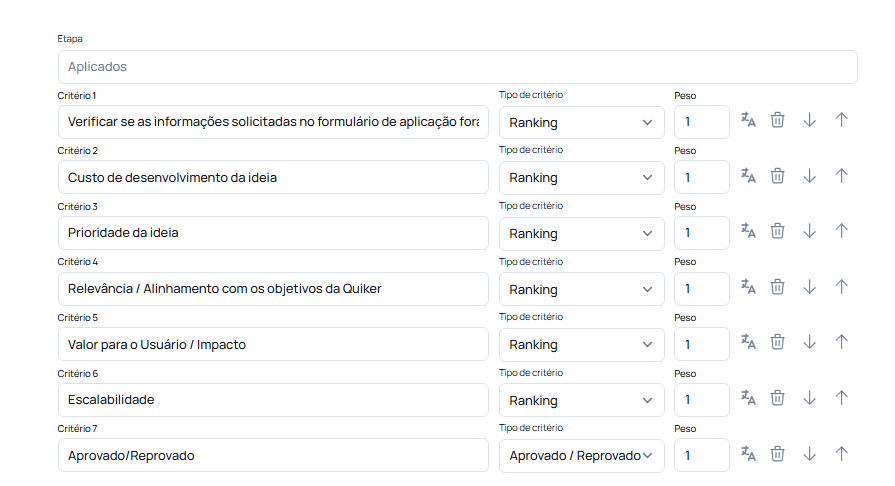
Element responsible for creating new criteria per stage, registration requires the registration of a **description **corresponding to the criteria and the definition of some resources available to categorize the criteria, such as:- Type of Criteria: You can choose between the “ranking” or “pass/fail” options. In the ranking format, proposals are evaluated with a score from 1 to 5, which classifies them in an order of preference, where 1 represents the least relevance and 5 the greatest. On the other hand, the pass/fail type adopts a binary approach, facilitating screening based on criteria that eliminate proposals that do not meet the requirements.
- Weight: Allows you to assign a specific relevance to each criterion in the evaluation, determining which factors will be most influential in the decision-making process. Criteria with greater weight will have a greater impact on the classification of proposals.
- Translation: This functionality allows you to add translations for the criteria in different languages, ensuring that the process is accessible to multilingual participants and collaborative on a global scale.
- Delete Criteria: If a criterion becomes unnecessary or irrelevant, the user has the option to delete it. This action helps keep the evaluation criteria lean and efficient, avoiding confusion among evaluators.
- Movement: This option offers flexibility in organizing the criteria throughout the stages, enabling reordering according to the needs of the evaluation. Thus, it is possible to prioritize or reevaluate criteria to reflect the company’s strategy in real time.
**Evaluation Criteria Configuration Guide
This guide guides you step by step through creating and customizing the evaluation criteria for a call on the platform. Below, examples and tips are presented to assist in structuring, ensuring that the entire selection process is refined by coherent and strategic criteria.
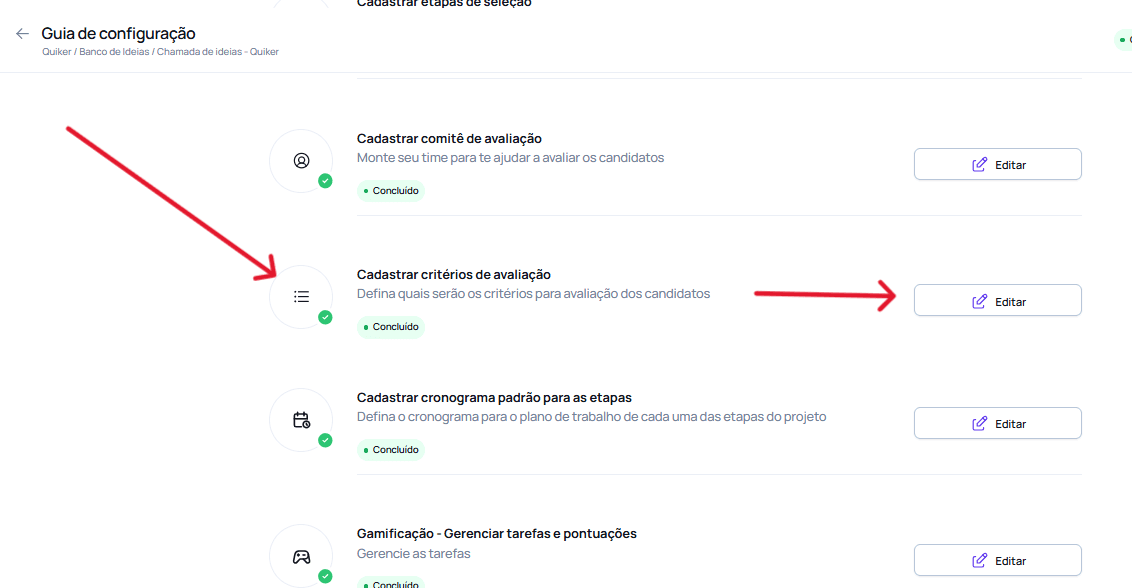
Step 1: Access Assessment Criteria Registration
- On the platform, when editing the call, go to Register Evaluation Criteria > Register Criteria
Step 2: Assessment Criteria
This session will involve creating and/or editing the evaluation criteria for an innovation call. The criteria may vary from one call to another depending on the type of innovation explored in the program, as well as the defined strategy and target audience. In general, the evaluation criteria must take into account the expertise and area of knowledge of the professionals who will be responsible for evaluating the proposal at each stage, with sets of criteria being recommended that are correlated per stage, but plural between stages. Below, we present examples of evaluation criteria for stages conducted by specific committees: investigation (innovation committee), technical evaluation (operational and technological committee) and executive evaluation (executive and administrative committee).
1. Applied Stage
Users submit their ideas through the application form on the platform and the applications are directed to the applied stage, which stores the proposals until the first analysis and screening.
_Examples of Criteria:_1. Completeness: All mandatory information and fields were filled out correctly.
- Binary type criterion (pass/fail), which aims to initially clear incomplete or poorly completed ideas.
-
Compliance: The proposal meets the basic requirements of the program, such as being an original idea and being aligned with the program’s objectives.
- Binary type criteria (approved/failed), which aims to adapt the ideas received with the strategic objective, ensuring that ideas, even good ones, are developed at the right time in accordance with the organizational strategy defined for the innovation call.
-
Clarity of the Proposal: Is the idea clearly described and understandable?
- Ranking type criteria (score from 1 to 5), which aims to score the best ideas during this stage to prioritize the best if the call has many applications.
By default, at this stage, an innovation horizon criterion is created that aims to size the potential impact that an idea can offer. These are classified into Horizon(H) 1, 2 or 3, with H1 being a more incremental innovation potential and H3 being a possible more disruptive innovation.
2. Verification Stage
_Build-up stage, concentrates the ideas pre-filtered in the previous stage and ensures that all proposals are ready to be evaluated by different committees in stages.
Examples of Criteria:
-
Required Resources: Assessment of necessary resources (time, team, technology, budget).
- Ranking-type criterion (score from 1 to 5), which quantifies, with a preliminary view, how much effort will be needed to select and develop the idea proposal.
-
Internal Support: Level of internal support and engagement for the implementation of the proposal.
- Ranking-type criteria (score from 1 to 5), which establishes the level of engagement that the idea would require internally from different teams, sectors and strategic areas of the institution to be implemented.
-
Risks and Mitigations: Identification of possible risks and mitigation strategies.
- Ranking-type criterion (score from 1 to 5), which aims to size the possible details surrounding an idea before time and resources are allocated to it.
3. Technical Assessment Stage
Technical evaluation stage, focused on analyzing the feasibility and robustness of the filtered ideas, considering specific aspects such as technical requirements, complexity of implementation and adequacy to the institution’s standards.
_Examples of Criteria:_1. Technical Complexity: Assessment of the technical complexity of the proposal in terms of requirements, technologies involved and integration with existing systems.
- Ranking-type criterion (grade from 1 to 5), which measures the level of technical complexity, considering implementation challenges and compatibility with the current infrastructure.
-
Technical Sustainability: Assessment of the sustainability of the project, taking into account maintenance, the need for updates and the support necessary for its continued operation.
- Ranking-type criterion (grade from 1 to 5), which examines ease of maintenance and long-term support.
4. Executive Committee Stage
Executive committee reviews submitted proposals; criteria-based strategic assessment . Interviews may be necessary and presentations may be carried out to better understand the ideas.
Examples of Criteria:
-
Scalability: Analysis of the idea’s ability to expand, considering its applicability in different contexts and its potential for adaptation to future demands.
- Ranking-type criterion (score from 1 to 5), which measures the scalability of the proposal and its potential for growth and flexibility.
-
Competitive Advantage: Does the idea create a relevant competitive advantage? How does it compare to the market and competitors?
- Ranking type criterion (score from 1 to 5), which measures the competitive advantage provided by the proposal and its potential for differentiation in the market.
-
Return on Investment (ROI): Does the proposal present a financial return or quantifiable benefit in relation to the costs involved? Is there a potential return proportional to the necessary investment?
- Ranking type criterion (score from 1 to 5), where the higher score represents a more attractive ROI, considering the balance between implementation costs and expected benefits. This criterion evaluates the cost-benefit ratio of the proposal and its ability to generate financial return or tangible value for the company within a reasonable period.
-
Potential Business Impact: What is the expected financial and organizational impact of implementing this proposal on a large scale?
- Ranking-type criterion (grade from 1 to 5), evaluating the projection of financial return and the impact on organizational efficiency.
6. Selected Stage
The Selected stage is intended for approved ideas to advance to the implementation and execution phases. At this stage, proposals are consolidated and ready to become active projects, with a detailed action plan.
Examples of Criteria:
-
Readiness for Implementation: Is the proposal ready to begin development and implementation?
- Binary type criterion (approved/failed), indicating whether the idea has all the necessary approvals and resources to start.
7. Declined Stage
At this stage, ideas that did not advance are sent for a final review and may be reconsidered in the future depending on their potential. Proposals that do not meet the minimum criteria or that do not yet align with the strategy are kept here.Examples of Criteria:
-
Justification for Decline: Was the proposal properly evaluated and are the reasons for the decline well documented?
- Binary type criteria (pass/fail), ensuring that the evaluation process is transparent and that the reasons for decline are clear.
-
Recap Potential: Does the idea have promising potential and can it be revisited in future calls or with adjustments?
- Ranking-type criterion (score from 1 to 5), helping to identify proposals that, despite not progressing, present potential for future opportunities.
Post-Registration of Assessment Criteria
After completing the registration of the evaluation criteria, it is important to review all the settings and ensure that everything is as desired. Below are some guidelines:
Criteria View
Once the call was published and applications for submission of ideas were received, the proposals became available in the selection funnel. The criteria will be available for evaluation at each phase defined in the funnel, as well as registered, allowing the proposal to be evaluated individually and counting the score of the idea quantitatively and qualitatively, through the notes and weight of the committees’ evaluations. The visualization of criteria can be configured according to user profiles and roles, allowing different visualizations of criteria, for different groups of evaluators, depending on the need for the innovation call. This configuration is carried out in the next stage of Configuring the Innovation Committee and assists in the segmentation, standardization and organization of the proposal selection process.
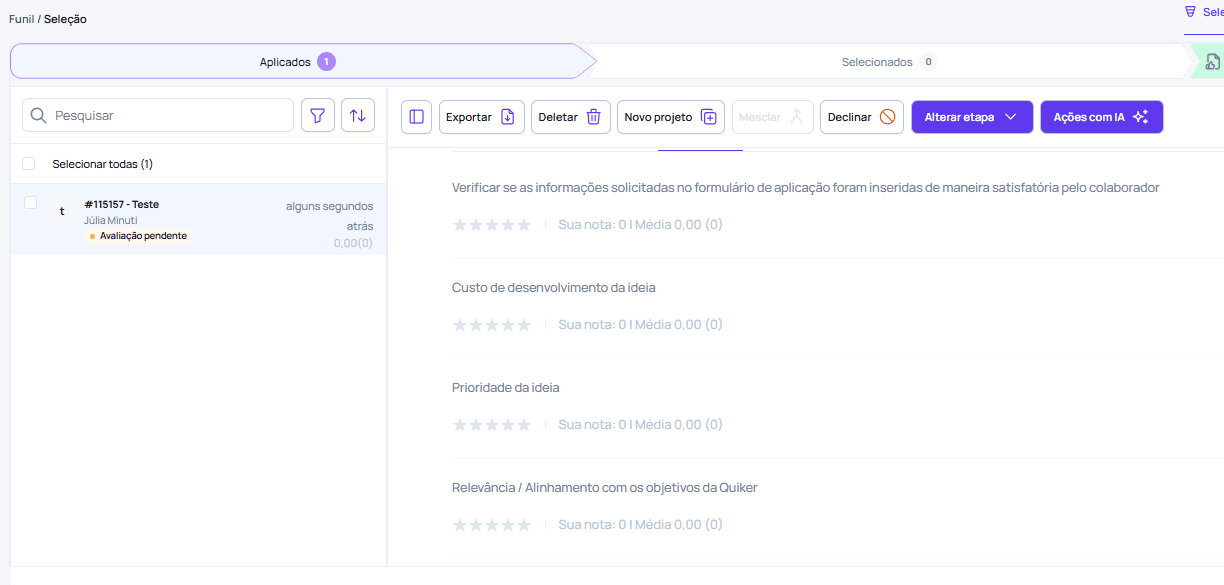
By establishing solid evaluation criteria, you ensure an efficient and careful process to identify the proposals with the greatest potential, making the selection more aligned with the objectives of the call and facilitating the management of each phase.
Proceed setting up the call in the next steps before publishing it.
We can’t wait to hear the innovative ideas and visions each participant will share!